

Well, this blog started as "The 1930s culture blog", so occasionally I will go back to that subject.
Here's Schoenberg's 3rd string quartet, in a historic recording from the 1930s. It's the Kolisch quartet supervised by Schoenberg himself. he first movement in particular is just awesome.
PART 1
PART 2
PART 3
PART 4
I own this quartet in a more recent recording with the New Vienna String Quartet
Showing posts with label Classical music. Show all posts
Showing posts with label Classical music. Show all posts
Thursday, February 26, 2009
Schoenberg: String Quartet no. 3

Sunday, February 15, 2009
Iannis Xenakis: "Synaphaï" and "Khoai"
Try to imagine this picture made into sound:
Until now I'd thought that the works of Iannis Xenakis I'd heard were a bit too 'intellectual' compared to the beautiful and (relatively) accessible compositions of Gyorgy Ligeti. But yesterday I listened to the big orchestral epic "Synaphaï" on headphones, and I suddenly 'got' it. Listening with headphones, it was like I was surrounded by clouds of strange and beautiful fractal shapes made into sound. An overwhelming experience! It's just incredible that he could make an orchestra sound like that, like the biggest and strangest synthesizer in the world. I'd suggest searching out this work, on "Orchestral Works vol. 3", or other discs in the "Orchestral Works" series. This series has proper 'surround'-like sound engineering, making it suitable for immersive headphone listening. Faar out, man! :-D
No, listening in bad sound quality on Youtube will NOT blow your mind, but here's an excerpt anyway:
As a bonus better suited for Youtube listening, here's a really cool - almost 'evil'-sounding Xenakis composition for hapsichord:
Friday, February 13, 2009
Milton Babbitt

And I'm STILL listening to all that inaccessible avantgarde crap.
Milton Babbitt (born 1916 and still alive) is American, and is noted for his uncompromising 12-tone compositions. After WWII it was mostly European composers like Stockhausen and Boulez who followed on from the 12-tone compositions of Schoenberg and Webern, but Babbitt is an example of an American doing the same.
Now I'm still not 100% sure I actually 'get' 12-tone compositions - to some degree they sound almost random to my untrained ear, because they're too complex for me to grasp the patterns. But I kinda like that, I find it comforting and relaxing. And I think the subconscious me may be able to spot the patterns in there, because part of me find the compositions very beautiful and fascinating.
There's some good Babbitt stuff on Youtube.
"Correspondences" for string orchestra and synthesized tape:
"Composition for guitar":
"All Set" for Jazz Ensemble (1957)
Tuesday, February 10, 2009
Wolfgang Rihm: "Jagden Und Formen"
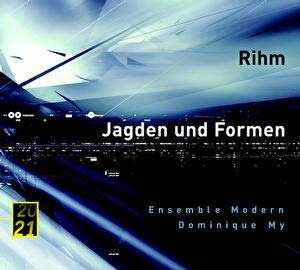
Getting into hardcore modern classical music is a bit like when I started listening to avantgarde electronica acts like The Aphex Twin and Autechre back in the good ol' 90s. At first the music doesn't make sense at all, then your brain slowly starts to be able to make sense of it... just about. It sure keeps you occupied.
Wolfgang Rihm is Germany's leading composer of modern classical music. He studied under Stockhausen in the 1970s. This is the beginning of his work "Jagden und Formen":
Monday, February 9, 2009
Schnittke: "Concerto Grosso no. 1"

I continue to delve into the world of composer Alfred Schnittke (1934 - 1998). The main attraction in a lot of his music is his use of horror soundtrack-like screaming modernist strings. Really great for an old Bernard Herrmann Hitchcock-score fan like me. I don't know if it's deliberate with those Hitchock-like birds on the cover above, but it would make sense.
That kind of music with screaming dissonant strings... at first it's somewhat annoying, but after you get used to it, it's like really cool guitar distortion in rock music - you can't get enough of it.
Anyway, I already explored his Piano Quintet and his four string quartets, and now I'm getting started on his concerti grossi ('big concerts'). The first one is just amazing, scored for two solo violins (it was comissioned by violinist Gidon Kremer), hapsichord, prepared piano (a piano made to sound 'weird' with various metal parts on the strings) and 21 strings
Here's one of the middle movements of the concerto in good sound quality:
Here's a live recording of the second movement:
The people who comment on the clips on youtube kinda gets it: "This stuff is so evil and dark sounding, but I love all the dissonance", and "It sounds something that came out of the movie "the nightmare before christmas" but much more better than that."
And here's the cover for the old edition of the concerto - couldn't resist posting it, because I love Russian constructivism:
Sunday, January 11, 2009
Schnittke's Piano Quintet

Russian composer Alfred Schnittke (1934-98) is known as a somewhat difficult modernist composer, but his piano quintet is a great discovery for me... it's got simple, almost childish piano themes, underscored with really sinister strings. The naxos CD, pictured above, is excellent.
Here's the final movement:
Thursday, January 8, 2009
Xenakis: "Herma"
Greek composer Iannis Xenakis(1922-2001)'s "Herma" is one of the most difficult piano pieces ever written. Xenakis used complex computer math to compose his music. I still don't quite 'get' his stuff - for all I know "Herma" might be some kind of advanced prank. But you know - I'd swear that it still has some kind of strange beauty to it. And it sure must take some dedication to learn to play it correctly.
Watch Japanese pianist Yuji Takahashi play the piece (with commentary in Japanese):
You can listen to it without commentary if you go HERE. Embedding was disabled so I could not put it in a window on this page.
Tuesday, January 6, 2009
Gyorgy Ligeti: "Hungarian Rock"
I remembered this Ligeti piece while I was walking in the woods. I thought I would create a dummy account on youtube and put it online, but someone had done it before me. No need for doing anything illegal this time, then.
The music is like... I dunno.... like deranged circus music played by a dwarf on speed in a Werner Herzog movie.
It's not being played by a human being - it has been programmed into a mechanical barrel organ. It's from the Ligeti CD "Mechanical Music". The Mechanical music of Ligeti was inspired by the player piano music of Conlon Nancarrow.
(I like the picture on the youtube clip too. It fits the music very well)
Monday, November 17, 2008
Anton Webern
Anton Webern took his teacher Arnold Schoenberg's twelve tone technique and and pared it down to the bare essentials - his pieces tend to be short, minimalist and quite unsettling. They are also probably nearly incomprehensible to the unschooled ear (including mine), but in a cool kinda way. It's really weird music, quite austere and beautiful.
Webern was shot at the end of World War II by an unhinged American soldier. There's a Thomas Pynchon quote from "Gravity's Rainbow" that kinda makes this into an epic conspiracy to keep advanced European music down. It kinda worked, in the end the more simple minded easy listening minimalist music of Philip Glass became the bestselling classical music.
"Shot in May, by the Americans. Senseless, accidental if you believe in accidents -- some mess cook from North Carolina, some late draftee with a .45 he hardly knew how to use, too late for WWII, but not for Webern. The excuse for raiding the house was that Webern's brother was in the black market. Who isn't? Do you know what kind of myth that's going to make in a thousand years? The young barbarians coming in to murder the Last European, standing at the far end of what'd been going on since Bach, an expansion of music's polymorphous perversity till all notes were truly equal at last. . . . Where was there to go after Webern? It was the moment of maximum freedom. It all had to come down. Another Götterdämmerung."
Drei Kleine Stücke Opus 11
Symphonie Opus 11:
Sunday, September 7, 2008
Messiaen's bird music
No more embarrassing drunken experiments for now. *blush*
I spent one of the (probable) last summer days today riding around in the countryside on my bicycle, while I was listening to Olivier Messiaen's piano music inspired by bird song - turned down so low that the sounds of the countryside and the real birds were still getting to me too in between the often thinly spread piano notes.
One of the weird aspects of delving into some of the more far out 20th century classical music is the phases you often have to get through where you at first feel like shouting "The emperor has no clothes!" and "That's just random noise!" and "A cat walking across the keyboard could have played that!", and then suddenly you get to a point where you start to recognize the alien beauty of it all.
Messiaen's bird music is a case in point. At first it does sound somewhat random, but before you know it you get into it, and you start to think about the wonders of nature, and about the genetic relationship between birds and humans, and about whether bird song and human music serve some of the same functions.
After the second world war, Messiaen became an older guru for young radical composers (Stockhausen, Berio, Boulez etc) gathering every summer in the town of Darmstadt in southern Germany. While most of the time was spent discussing advanced mathematical methods for composing music, at some point Messiaen started praising bird song and arguing that birds are the greatest musicians of all. And then he started releasing music based on field research into bird song. It all seemed to fall somewhere between a dadaist prank and something artistically fairly sensible, considering that most humans find bird song quite beautiful.
Here are som youtube clips.
Messiaen discussing bird sounds:
More info here:
And some of his bird music:
Saturday, August 30, 2008
Latry & Messiaen
 And now I'm listening to the box-set of Olivier Latry playing the complete organ works of Messiaen. This shit is insane. I know it's supposed to be devotional music, but some of it is just cascades of crazy dissonantic chords played on the Notre Dame organ, one of the best sounding organs in the world. Definitely an experience, especially on a stereo set with proper bass.
Here are recordings of Latry playing Messiaen on another organ:
And here's Latry improvising on the Notre Dame organ
Wednesday, August 27, 2008
Olivier Messiaen and the Ondes Martenot
In my personal journey through 20th century classical music I've now started to seriously explore the works of Olivier Messiaen. I've never really gotten around to listening to his stuff before, mainly because the only things I knew about him were that A) he was a Christian and wrote a lot of devotional music, and B) he became obsessed with the sounds of birds and tried to emulate it in his music. It sounded a bit... uh... well... gay.... anyway, after spending a couple of days exploring his stuff I can already say that it's actually quite magnificent. And some of that devotional music... it's quite insane... Messiaen believed that not only regular minor and major chords should be used in the church... according to him, crazy dissonantic chords could be used too. And some of that stuff is awesome.
But never mind the dissonance for now, whats even more cool is that Messiaen also wrote some pieces for the early French proto-synthesizer, the Ondes Martenot.
The Ondes Martenot was an early electronic instrument that was invented in 1928. It sounded somewhat similar to the slightly more well known Theremin (used in the Beach Boys "Good Vibrations" and lots of old sci fi soundtracks). In recent years the sound of the Martenot has reached a large audience thanks to Jonny Greenwood of Radiohead, who's used it on Radiohead albums since "Kid A", and also used it on the acclaimed soundtrack for "There Will Be Blood".
But Messiaen was one of the first composers to champion the instrument.
Here are two clips of a group of people performing his "La Fête des Belles Eaux" written for six Martenots.
Here is a clip that demonstrates how the instrument works:
And here's another clip, an excerpt from the large orchestral work, the Turangalila Symphony:
Thursday, August 21, 2008
Schoenberg's "Serenade" Opus 24
I'm currently grooving to Schoenberg's "Serenade", a cool piece of music scored for eight players that include a bass, guitar and mandolin. It's almost rock n roll. Well, it DOES rock in an offbeat way a little bit like Captain Beefheart's "Trout Mask Replica", anyway.
Here's a youtube clip with an excerpt (the complete piece is 32 minutes long):
I'm listening to the version on this cd: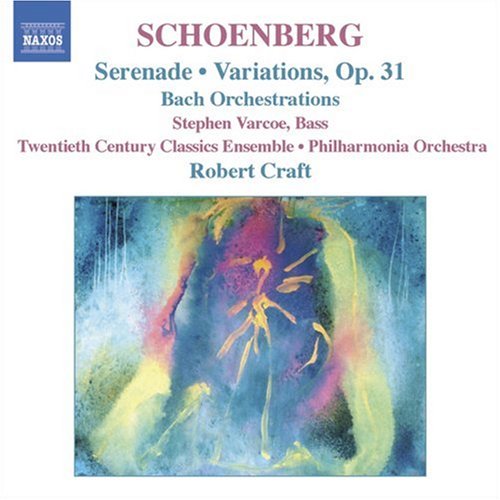
Friday, August 15, 2008
Lux Aeterna

I'm reading the Ligeti biography "Music of the Imagination". Among the many revelations is this: The 1960s 'psychedelic' sounding work "Lux Aeterna" (used in Kubrick's "2001") WAS in fact composed on drugs. Because of an illness Ligeti had become addicted to morphine in this periode, and he was forbidden to walk on the streets by himself because he was too out of it. So he WAS in tune with the sixties after all.
Listen to Lux Aeterna:
I caved in and ordered the new cheap 5 cd box-set, even though I already own two of the cd's. Still cheaper than buying the individual cd's. This box has all the really big weird works for choir and orchestra. Highly recommended!
The story behind this box from Teldec is that Sony originally started out doing the complete Ligeti series. But they weren't able to produce the most complicated orchestral works to the composers satisfaction. So they only did the more simple works for solo piano and the chamber music and stuff like that, on 8 cd's. Then Teldec eventually stepped in and produced the remaining 5 cd's, now released as a set.
Monday, August 4, 2008
Alex Ross: "The Rest is Noise"

I'm working my way through Alex Ross' "The Rest Is Noise". This book (published last year) is what I have been looking for: an intelligent and readable account of 20th century 'serious' music.
Ross is a music critic for The New Yorker, and the great thing about this book for those of us who know more about rock music than classical, is that Alex Ross in a sense is one of 'our' guys too- he's not one of those classical music writers who are completely distant alien beings who know nothing about the world of serious popular music. Looking through his blog, I notice that Ross has also written fine articles about artists such as Kurt Cobain and Pavement, and his playlists include works by Portishead, Björk, Sonic Youth, Antony & The Johnsons, Justin Timberlake, Bob Dylan, Radiohead etc etc. So basically he's a great guide into this alien world for an old rock listener like me. And he's a damn fine writer too.
The book starts out covering some of those gateway composers that helped usher in 20th century music, particularly Richard Strauss and Gustav Mahler and Maurice Ravel. Then it moves onto the music of the 1920s and 1930s - Stravinsky, Arnold Schoenberg and his followers, Bartok, Janacek, Charles Ives, Duke Ellington, Gershwin, Kurt Weill and the Berlin scene, and then moves through the decades until it arrives at later giants like Stockhausen, Luciano Berio, Olivier Messiaen, Benjamin Britten, Gyorgy Ligeti, Steve Reich, Philip Glass etc etc. It also touches briefly on The Beatles and The Velvet Underground and a few other rock groups that were influenced by (and influenced) the classical avantgarde.
Wednesday, June 25, 2008
Hilary Hahn does Schönberg

Currently listening to Hillary Hahn's new recording of Schoenberg's violin concerto (composed in 1935-36). When Schoenberg wrote it, famous violinist Jascha Heifetz declared that it could only be played when violinists started to grow 6 fingers. It's never become part of the standard repertoire, but a few later violinists have managed to wrap their hands around it.
You can listen to some of Hahn's version at her myspace page. (NOTE: At some point clicks start to appear for copyright reasons). This is the andante, so I presume it's not the most difficult part of the concerto. It does get pretty wild towards the end though.
The concerto is also an example of 12-tone music that's actually very accessible.... or FAIRLY accessible at least. It reminds me a bit of Bernard Herrmann's Hitchcock scores and parts of Howard Shore's David Cronenberg scores. I like it very much. There's also a Sibelius thingie on the disc, but I haven't gotten round to listening to it yet, I have the Schoenberg on repeat.
Sunday, June 8, 2008
György Ligeti

In the past year I've seriously fallen in love with the work of Hungarian composer Gyorgy Ligeti. Like most movie buffs, I've always known the music that was used in some Stanley Kubrick films, particularly in "2001: A Space Odyssey", but for some reason I'd never gotten round to listening to his other stuff. I dunno why. Maybe I thought it would be too 'difficult' or something. Well, it's not, really. it's beautiful.
If you need to remind yourself what the "2001" music sounds like, then here's a couple of youtube clips. The main pieces used in that movie are "Atmospheres" (for orchestra), "Lux Aeterna" (for choir) and "Requiem" (for choir)
These pieces are written in the spacey microtonal 'cloudy' style he used in the 1960s. However, being a real artist always looking for new frontiers, he didn't keep on writing in this style forever. He moved towards a more 'clear' and mathematical style in later works, particularly after he discovered fractal math and the works of composer Conlon Nancarrow in the 1980s and started writing his piano works and works for mechanical instruments.
Here are two examples of his powerful Piano etudes, these are known as "Autumn in Warsaw" and "The Devil's Staircase":
And here's a nice recording of two of the six short and accesible 'bagatellen'
And the first movement from the first string quartet:
To get started on Ligeti, the best way is probably to buy "Clear and Cloudy", the budget 4CD box of his works on Deutsche Grammophon. This includes all the famous "2001" pieces, plus his string quartets and some mind blowing organ works, and various other goodies. It has a pretty cool 'rock n roll' cover too: However, there's a lot of cool stuff not included in that box. The "Ligeti Project"/"Ligeti Edition" is a series of CD's (the series was started by one record company and finished by another, that's why it has two titles - there's an overview of the series HERE) that more or less include his complete works. Not every CD in the series is a complete hit... some of them include too much early work from the 50s that's usually nice enough, but not really mind blowing on the level of his later mature works.
The two most essential of the discs that I own are probably these: "Ligeti Edition 5: Mechanical Music" features music not actually played by human beings, its too fast and complex to be played by a human. It has been programmed into barrel organs and mechanical pianos. Particularly the music for barrel organ is stunning and beautiful, featuring harmonies that are simply out of this world, yet also at the same time very accessible. This has become one of my favourite cd's of all time.
 "Ligeti Edition 3: Piano Works" features his famous piano etudes, and it's a really nice collection of modern piano music.
Edit: and apparently there's a new budget box set out which collects the 5 Ligeti Project CD's. Even though the fifth and last cd is mostly scraping the bottle of older stuff, the four other cd's should make this a serious rival to the "Clear and Cloudy" box as a nicely priced introduction.
Friday, May 2, 2008
Conlon Nancarrow (1912-1997)

In recent months I've become a bit of a Nancarrow fan.
Conlon Nancarrow, one of the greatest, and strangest, composers of the 20th century, lived in isolation from the rest of the musical community in Mexico City. Starting in the 1940s, he composed music almost exclusively for the player piano. That is, he plotted his compositions directly onto the piano roll, in effect producing something very similar to computer music. Initially somewhat inspired by boogie woogie and jazz, these compositions became more and more complex. Only a few of them can, in somewhat simplified form, be played by humans.
Nancarrow remained an obscure composer until leading avantgarde composer Gyorgy Ligeti discovered him and started talking about Nancarrow as being the greatest composer of the 20th century.
"This music is the greatest discovery since Webern and Ives... something great and important for all music history! His music is so utterly original, enjoyable, perfectly constructed but at the same time emotional...for me it's the best of any composer living today." - Gyorgy Ligeti
There's an online article about him here.
This video features 8 minutes of Player piano music by Nancarrow:
Here's another slightly shorter video:
More info and links about Nancarrow at the Nancarrow Wiki page.
Monday, April 14, 2008
Schönberg: Pierrot Lunaire, string quartets
 My music listening is still in a dark Schoenbergian phase, getting into this unsettling stuff has been a major revelation. Currently I'm listening to my new CD of "Pierrot Lunaire", the adaptation of 21 poems by Belgian symbolist poet Albert Giraud.
Here's a better translation than the subtitled one in the clip:
"Night"
by Albert Giraud
Sinister giant black butterflies
Eclipse the blazing disk of sun.
Like a sealed-up book of wizard's spells
Sleeps the horizon--secret silent.
From dank forgotten depths of Lethe
A scent floats up, to murder memory.
Sinister giant black butterflies
Eclipse the blazing disk of sun.
And from heaven downward dropping
To the earth in leaden circles,
Invisible, the monstrous swarm
Descends upon the hearts of men,
Sinister giant black butterflies.
The String quartets are also fantastic. Sounds like Bernard Hermann's Hitchcock scores, except a lot weirder.
Monday, December 24, 2007
Arnold Schönberg videos

Schönberg was one of the founding fathers of 20th century music.
Schönberg's 12-tone technique explained:
Pianist Mitsuko Uchida on Schönberg's Piano Concerto (1942)
Many more Schönberg related videos posted by the Arnold Schönberg Center are available on youtube. This is a great resource that I've got to explore further.
Schönberg's paintings and drawings are also very good. You can look at them at this site.
I particularly like these two, so I'll post them even though they're somewhat earlier than the 30s:

Subscribe to:
Posts (Atom)

